CBT in the Arab World: Cultivating Learning, Practice, and Transformation
A Personal and Professional Journey
My initial encounter with cognitive behavioral therapy (CBT) was simply an academic exploration of one therapeutic approach among many. However, this academic interest quickly evolved into a profound personal and professional calling, powerfully shaping my career and ultimately sparking a movement for psychotherapy education across the Arab world.
During my second year of university, I was introduced to CBT. At the time, I was deeply drawn to Carl Rogers and the humanistic tradition, with its emphasis on empathy, relational depth, and the inherent potential for growth. Yet, Aaron Beck’s cognitive model, with its elegant and practical connection between thoughts, emotions, and behaviors, resonated deeply within me. I recognized it not merely as a theory, but as a practical tool for living, something that could be applied, shared, and taught.
As someone dedicated to mental health, I didn’t just study CBT; I actively integrated its principles into my own life. It wasn't an academic exercise, but a method to navigate challenges, alleviate self-doubt, and modify unhelpful beliefs with curiosity rather than judgment. This experience was transformative, instilling a profound sense of clarity and responsibility: I knew I needed to bring this back home.
"Home" encompassed not only a physical location but also a cultural and linguistic landscape. In Lebanon and the wider Arab world, psychotherapy education has historically been heavily influenced by Western thought. While theories and approaches have been translated and adapted, much has been lost in this process, both literally and culturally. Concepts often arrived in our region devoid of the lived experience and language that would allow them to truly resonate.
I identified significant gaps in accessibility, linguistic familiarity, and cultural relevance. While I witnessed immense passion among students and clinicians, structural support for training was limited. Yet, I also saw enormous potential, waiting for the right structure, community, and language to be fully realized.
This is where my journey truly began.
The Genesis of CBT Study Groups: Addressing Need and Opportunity

In early 2020, as the COVID-19 pandemic imposed global isolation, it simultaneously opened new avenues for connection. Online learning transitioned from a novelty to a necessity. I recognized an opportunity not just to teach CBT, but to foster a collaborative learning environment.
Thus, the first CBT Study Group was formed.
It started simply: six participants from diverse backgrounds, each week bringing their curiosity and eagerness. Our group comprised psychology students, early-career therapists, and individuals from other professions drawn to CBT. Together, for six months, we committed to weekly reading, meetings, sharing, questioning, and practicing.
The structure was deliberate: flexible yet anchored. Each session included a review of the week’s readings, guided discussions, role-plays with constructive feedback, and dedicated space for personal reflection. The group's unique spirit—collaborative, open, emotionally grounded, and deeply human—truly set it apart.
CBT transcended mere academic study, becoming a way of life.
That initial group led to a second, and then a third. Over the months and years, the CBT Study Group evolved from a singular entity into a vibrant community of practice, now encompassing:
- 21 Level 1 cohorts
- 5 Level 2 cohorts
- A Level 3 cohort
Over 150 participants from across the Arab region.
These study groups were not formal training programs but rather a gateway to CBT, a safe and structured transitional space for individuals to explore whether CBT was truly their chosen path. Many subsequently pursued full certification with international institutions. Others confidently began integrating CBT into their clinical practice with greater depth.
The movement's growth was driven not by marketing, but by meaning. It flourished through word-of-mouth, trust, and authenticity. People joined seeking not just knowledge, but guidance, space, and meaningful conversation. They yearned to feel understood in their learning journey and connected in their personal and professional growth.
Crucially, they desired to experience CBT in a way that authentically reflected their culture, language, and lived realities.
A Transformational Space: The Impact of the Study Groups

Over time, the CBT Study Groups evolved beyond a series of learning opportunities. They became a shared experience of conceptualizing, articulating, learning, and practicing therapy in Arabic—and with direct relevance to our lives as Arabs.
Participants came from diverse backgrounds: some were pursuing psychology degrees, others were licensed clinicians seeking structure and mentorship, and some hailed from entirely different disciplines, driven by a personal need for understanding and healing.
What united them was not a shared identity, but a common aspiration: to learn CBT not just as a therapy, but as a process of personal growth.
Almost every participant expressed sentiments similar to: "I didn’t realize that learning CBT would change not just my work, but my life."
Each time I received such feedback, I was reminded that when therapy education is grounded in conversation, reflection, and cultural resonance, it transcends mere skill acquisition and becomes an integral part of who we are.
The study groups empowered participants to:
- Acquire solid foundational knowledge in CBT theory.
- Enhance client work through structured case conceptualization.
- Develop confidence in role-plays and interventions.
- Feel connected to a regional community of learners.
- Prepare for formal and certified CBT training programs.
The transformation extended beyond cognitive understanding; it was relational, emotional, and practical. Many participants described the study groups as "safe," "grounding," and "hopeful." For some, these weekly meetings became a vital support system during times of distress, uncertainty, or crisis.
This profound impact matters, not only because supported learning is more effective, but because it fundamentally alters how therapists engage with their clients.
These study groups fostered a sense of collegiality among students, built interpersonal trust into the learning process, and helped a generation of Arab practitioners see themselves as integral to a global movement, with their own distinct voice and value.
That voice became even clearer the day I began writing the first Arabic guide to learning CBT.
A Book with Arab Identity: Crafting A CBT Manual in Arabic
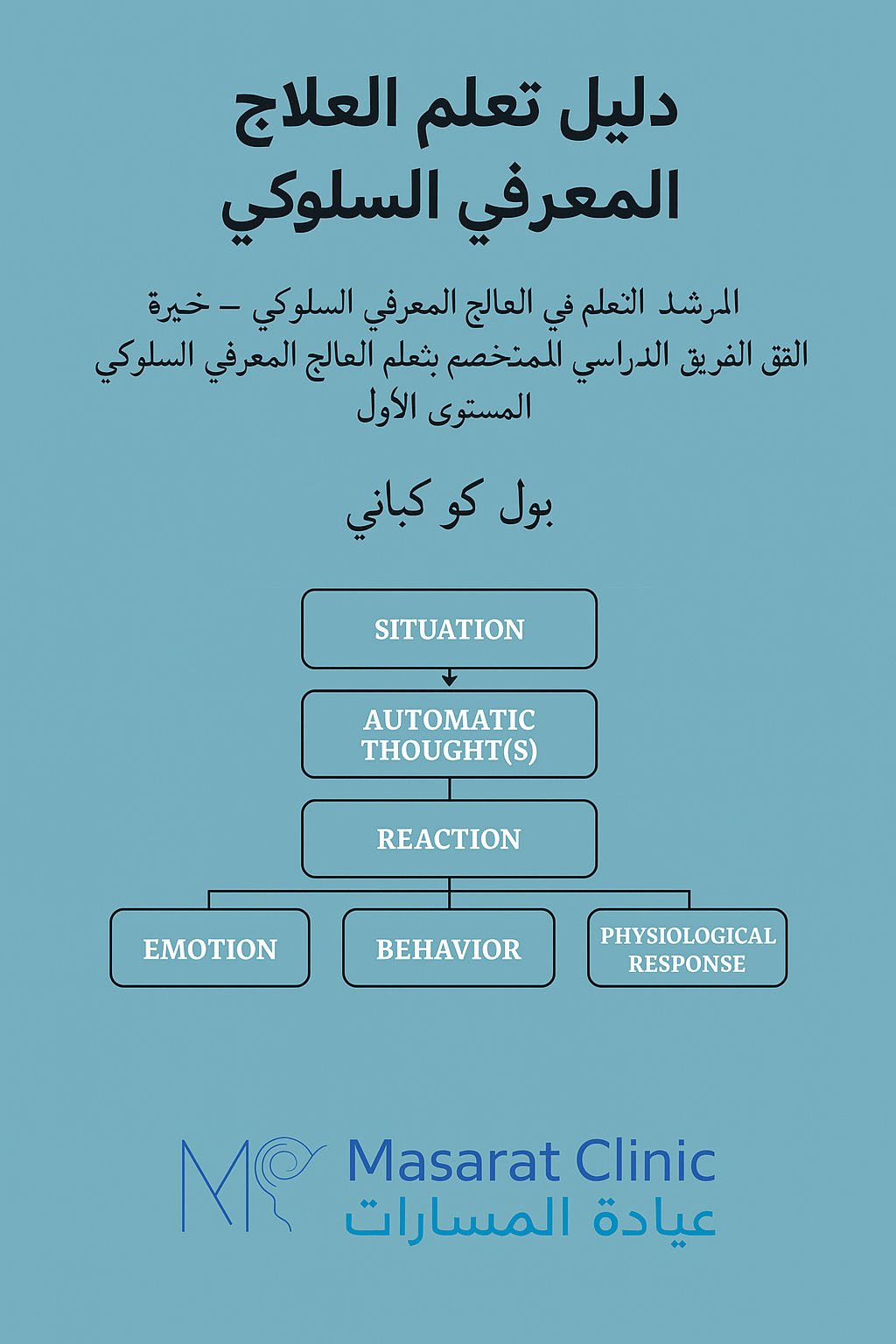
Writing دليل تعلم العلاج المعرفي السلوكي (Guide to Learning CBT) was a decision I made with careful consideration. It emerged organically from the study group experience and the pressing need for a culturally relevant and structurally organized manual in Arabic.
The book originated as notes, reflections, and exercises shared with study group participants, but it quickly became evident that something more substantial was required. Not merely a translation of Western CBT manuals, but an original text: one rooted in our specific context, grounded in the Arabic language, and fueled by years of collective learning.
Its creation spanned several years, a period marked by:
- Training in ACT, DBT, Schema Therapy, REBT, CFT, MI, SFBT, and CPT.
- Navigating national financial collapse.
- Continuing clinical work during and after the Beirut blast.
- Supporting learners amidst war and displacement.
- Rewriting content to maintain relevance with real-life examples and daily experiences.
- Translating psychological concepts in a way that resonated authentically in Arabic.
Both the challenge and the reward lay in the same element: language.
Arabic is poetic, multi-layered, emotionally rich, and abundant in metaphor. Expressing clinical concepts with both scientific precision and cultural resonance demanded creativity, extensive revision, humility, and courage.
And it proved successful.
Upon the book's release, readers from Lebanon and beyond reached out, sharing that they finally felt CBT was "theirs" not something borrowed or foreign, but something familiar, useful, and profoundly meaningful.
That was the moment I realized the profound significance of this work: not because I had simply written a book, but because something important was being claimed: a space for CBT in Arabic, not as a translation or imitation, but as an act of ownership and a genuine contribution.
The Cultural Bridge: Why CBT Resonates in the Arab World
Many inquire: "Does CBT even work in Arab culture?"
My consistent response is: CBT works wherever there are humans.
CBT resonates within the Arab world not because it requires adaptation, but because it inherently aligns with our values, such as reflection, meaning-making, deep contemplation of suffering, and the honoring of family, community, and resilience.
The misconception that CBT is "surface-level" quickly dissipates once individuals experience its full depth, exploring core beliefs, identity wounds, trauma patterns, existential evaluations, and the narratives we construct when feeling isolated or misunderstood.
CBT offers more than just an approach; it provides a pathway. A structured way to understand pain, respond to it, and forge meaning despite it.
To achieve this responsibly, two elements are essential:
- Scientific integrity
- Cultural sensitivity
Because treatment is designed to help people and not the other way around.
Looking Ahead: A Collective Mission for the Future
Today, my work continues through:
- Coordinating and expanding the CBT Study Groups.
- Offering free public webinars and introductory workshops to reduce barriers to access.
- Writing additional Arabic materials to support learning and outreach.
- Developing Arabic video content on CBT concepts and tools.
- Supporting Arab clinicians in pursuing international CBT certifications.
However, the most exhilarating aspect of this journey is this:
The next generation has arrived.

They are advancing this work further: becoming certified clinicians, trainers, and advocates for psychotherapy within their respective countries and communities.
They will achieve things I have not. They will expand, teach, supervise, research, publish, and establish structures that none of us grew up with.
My aspiration is not to lead them, but to journey alongside them, not as the sole expert, but as a colleague, mentor, and fellow human being.
If this work leaves a legacy, let it be this:
That we created spaces where people could learn therapy in their own language.
That we trusted psychology to develop its own Arab identity, rather than merely borrowing from elsewhere.
That we approached education as a community endeavor, not a competition.
That we maintained belief in meaning, even amidst crisis.
And that we never forgot the simplest truth:
Hand in hand, we build a better world.
Paul Kawkabany, BICBT-CC, A-CBT
Licensed Clinical Psychologist and Psychotherapist
Beck Institute CBT Certified Clinician BICBT-CC
Diplomate of the Academy of Cognitive and Behavioral Therapies A-CBT