Welcome to the A-CBT Blog
Our blog is a space for learning, reflection, and growth. Here, we share practical tools, fresh insights, and real-world applications of Cognitive Behavioral Therapy to support both practitioners and curious readers alike. Whether you’re deepening your clinical practice or exploring ways CBT can enrich everyday life, you’ll find thoughtful articles, resources, and perspectives designed to inspire and empower.

When Parents Lose Control: Using CBT and DBT to Move from Shame to Repair Written by Matis Miller, LCSW, A-CBT, DBT-LBC

CBT for Young Minds: How Cognitive Behavioral Therapy Is Adapted for Children and Adolescents Written by Hakan Öğütlü, MD, MSc, Associate Professor, Consultant Child and Adolescent Psychiatrist

By Scott Waltman, PsyD, ABPP

By Dr. Robert L. Leahy PhD, The American Institute for Cognitive Therapy

Summer 2026

By Christopher Schamber, LCSW

Dating with Social Anxiety in the Digital Landscape by Chamin Ajjan, LCSW, A-CBT, CST
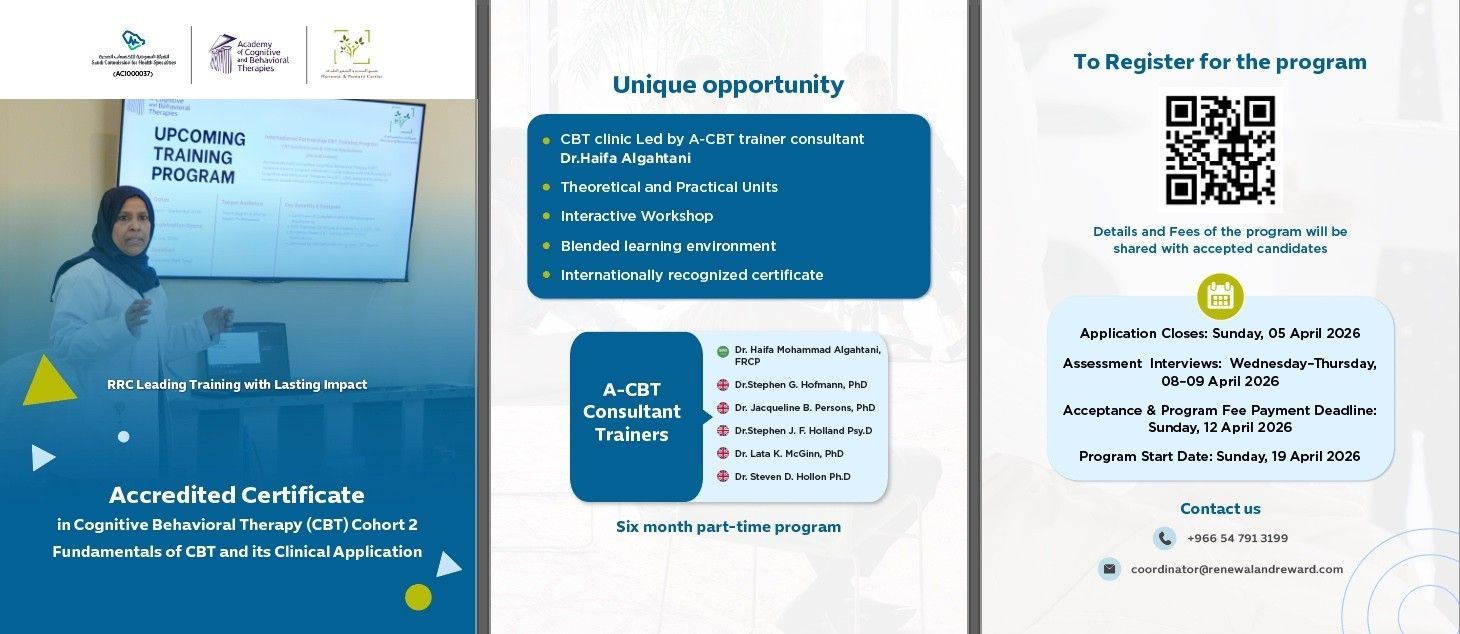
A Training Model Designed for Real Clinical Competence

I became a new mom over the last year and, as many people know, that experience completely rewires your brain. For me, it was not just the sleepless nights or the existential panic over whether my baby would nap for more than 27 minutes. It was the hormonal wiring for danger, turned up to warp speed. I found myself thinking things I would have laughed off before parenthood. The number of times I imagined tripping down the stairs or wondered whether eating .25 fewer ounces could somehow derail my infant’s entire day was absurd. Yet in the moment, it felt so real and urgent. I looked for answers wherever I could find them: books, friends, our pediatrician, and increasingly, AI. Yes, I asked ChatGPT so many questions about my baby’s sleep, his health, his routine, development markers—you name it. Part of this stemmed from the lack of community many of us have as parents in today's world, ironically fueled by technology itself, and part of it stemmed from my desire to keep my son safe. And the irony wasn’t lost on me; as an exposure therapist, I spend my days helping people step out of reassurance loops. These questions were quietly reinforcing my anxiety. As I leaned on AI support more, I was relying less on my own intuition and more on a machine to tell me what to think and do. I’ve watched this dynamic unfold in my patients for years - using Google, symptom checkers, calorie apps, texts to partners, or late-night forum scrolling. While the medium shifts, the mechanism stays the same. Could AI be a new form of reassurance-seeking? A digital ritual maintaining anxiety in ways we had not fully accounted for in CBT assessment? The Modern Ritual: AI as a Safety Behavior

From the perspective of Dr. Curtis Hsia, a psychologist and a practicing Christian

By Professor Emily A Holmes Department of Women’s and Children’s Health, Uppsala University, Sweden School of Psychology, University of Southampton, UK

A Personal and Professional Journey My initial encounter with cognitive behavioral therapy (CBT) was simply an academic exploration of one therapeutic approach among many. However, this academic interest quickly evolved into a profound personal and professional calling, powerfully shaping my career and ultimately sparking a movement for psychotherapy education across the Arab world. During my second year of university, I was introduced to CBT. At the time, I was deeply drawn to Carl Rogers and the humanistic tradition, with its emphasis on empathy, relational depth, and the inherent potential for growth. Yet, Aaron Beck’s cognitive model, with its elegant and practical connection between thoughts, emotions, and behaviors, resonated deeply within me. I recognized it not merely as a theory, but as a practical tool for living, something that could be applied, shared, and taught.