Can Clients Really Make New Discoveries in Every Session?
Can Clients Really Make New Discoveries in Every Session?
Written by Christine A. Padesky, PhD

On the first page of Dialogues for Discovery: Improving Psychotherapy’s Effectiveness we make a bold claim. We assert that our book is designed to teach therapists to have a therapy practice in which clients make “new discoveries every session and [use] those discoveries to either gradually or radically transform their lives” (Padesky & Kennerley, 2023, p.1). True or hyperbole? After nearly 50 years of teaching and practicing CBT, I believe this statement is true. Therapists can achieve this goal through radical applications of Socratic Dialogue.
For decades the CBT literature has been filled with references to Socratic questioning. While Tim (Aaron T.) Beck told me Socratic questioning was never a term he used in the early years of cognitive therapy (personal conversation, October 14, 2013), the phrase was there from near the beginning. It was perhaps introduced by Gary Emery who used it in a workshop I attended in the late 1970’s. By the mid 1990’s I stopped using the term Socratic questioning. I learned when I taught CBT that the phrase was often interpreted by therapists as a call for them to ask clever questions that would change a client’s mind. Instead, I firmly believed that a core tenet of CBT should be guiding client discovery, even when it led to places not envisioned by the therapist.
After many years of tracking my own questions in therapy, getting feedback from clients as to which questions were most helpful, and observing other therapists’ use of Socratic questioning in session recordings, I developed a 4-stage model of what I called Socratic Dialogue (Padesky, 1993).
1) Informational Questions
2) Empathic Listening
3) Summary of Information Gathered
4) Analytical and Synthesizing Questions
This model was designed to help therapists in my workshops and classes acquire verbal guided discovery skills that would be engaging and lead to client discoveries. A model like this is particularly helpful because guided discovery is one of the most challenging skills for therapists to learn (Waltman et al., 2017).
The term Socratic Dialogue was intended to remind therapists that informational questions were simply the beginning of the process (Stage 1). It was equally important to pay attention to client responses, including the words, images, and metaphors clients used (Stage 2). Further, I learned through my years of observation that client discoveries were more likely to come about when therapists and clients made written summaries of what the client said, in their exact words (Stage 3). These written summaries allowed clients to review the ideas gathered and answer key “analytical and synthesizing” questions that were springboards to discoveries and putting these directly into life practice (Stage 4).
My observation is that most psychotherapists, even non-CBT therapists, practice these first two stages (asking information questions and listening empathically) in almost every session. I’m convinced that it is the last two stages (written summaries; analytical and synthesizing questions) which ensure client discoveries are made. These two stages are relatively lacking in therapy sessions, even by many CBT therapists.
A clinical example illustrates the pivotal role played by the last two stages of Socratic Dialogue. Jemna is in therapy for help with depression. Between therapy sessions she agreed to do a variety of activities to see if her activities and moods are related. At the beginning of this therapy session, Jemna and her therapist debrief her week:
Therapist: How did you do with those activities we planned for this week? (Info Q)
Jemna: Not so well. I only did some of them.
Therapist: You just did some of them. Were they difficult for you to do? (Empathic Listening + Info Q)
Jemna: Yes. I just had a hard time getting going some days.
Therapist: Sure. Depression can really make it hard to get going. (Empathic Listening) Did you write down the ones you did do and rate your mood like we discussed? (Info Q)
Jemna: Yes. There’re not many things [Hands her activity schedule to the therapist].
Jemna and her therapist reviewed the six activities she recorded on her sheet and her mood ratings. Asking informational questions about each activity, her therapist linked her mood ratings to the activities. They noted that generally her mood was a bit better when she did activities such as cooking, talking to a friend on the phone, and walking in a nearby park. Her mood was worse after talking with her landlord about a planned rent increase.
At the end of a five-minute discussion of her weekly activity and mood ratings,
Therapist: It looks like most of the time, doing something helped you feel better.
Jemna: Yes, it’s just hard to get started.
Therapist: Sure. Given its helpfulness, do you think you’d like to continue planning activities for this week, and maybe we can figure out ways to help you get started?
Jemna: OK.
The session described here captures a fairly typical debriefing of between session learning. Notice that Jemna is able to remain fairly passive as the therapist organizes the information and suggests a session plan. Perhaps Jemna has made a bit of a discovery about activities and mood but she does not seem energized by it.
Let’s see how discovery looks different if, after their 5-minute discussion of her weekly activity and mood ratings, Jemna and her therapist make a written summary of what she has learned.
Therapist: Thank you for all those details. Let’s make a summary of what you learned this week.
Jemna: Okay.
Therapist: I’m writing at the top of this page, “What I learned about doing activities and my mood.” What should we write underneath (handing Jemna the pen)? (Info Q)
Jemna: I feel better when I do things.
Therapist: Okay. That’s important (encouraging remark). What else?
Jemna: Like we talked about, my mood seems better when I’m around other people. Like when I talked with my friend on the phone or ran into my neighbor in the park.
Therapist: Good observation. Write that down too. (Pause while she writes). Anything else?
Jemna: I can’t think of anything.
Therapist: How about feeling worse talking to your landlord? That’s being around other people but you didn’t feel better, you felt worse.
Jemna: Maybe it’s not just being around people but being around people I like.
Therapist: Okay. That might be important to write down.
[They continue to make a written summary of what Jemna learned helps her mood].
Therapist:
When you look at this summary, what do you think? (Synthesizing Q)
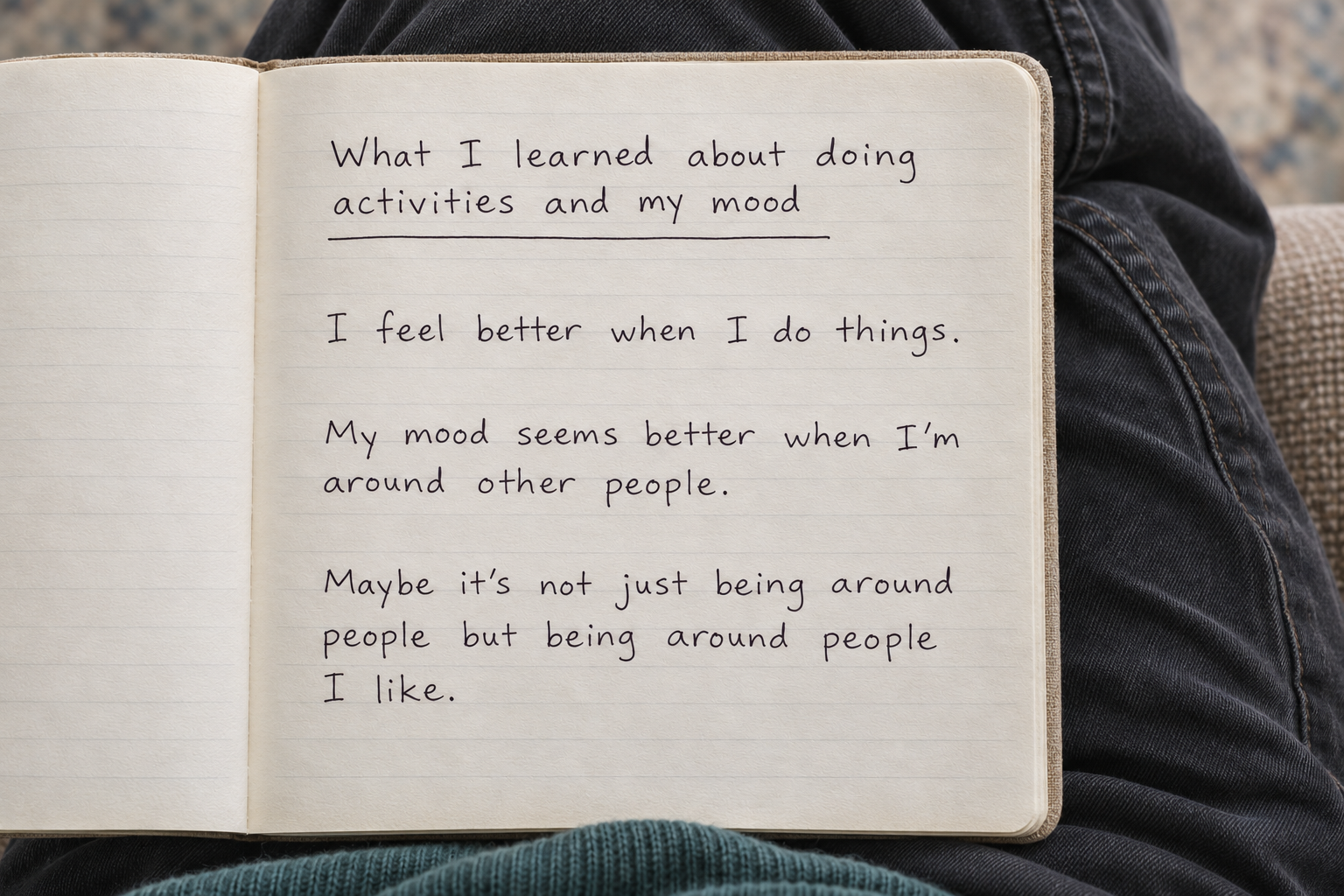
Jemna: Even though I just did some of the activities, there are quite a few things here.
Therapist: Yes, you learned a lot from this week. Look at this summary. What ideas does it give you for how you can make this coming week even better for you? (Analytical Q)
Jemna: (Thinking). I think it would be better for me to plan activities that I can do with other people rather than just on my own. Maybe even plan to go places where friendly people are likely to be.
Therapist: That’s an interesting idea. What ideas come to mind? (Analytical Q)
Jemna: (Silent for a minute) There is a coffee shop I can walk to from my apartment. It has really good energy and I like the people who work there. Maybe if I went there for my morning coffee that would help me get started on a hard day. You know, it might lift my mood to be around people and have a bit of conversation.
Therapist: I can see that idea kind of excites you (Empathic Listening)
Jemna: It really does. When I feel bad, I tend to isolate. But maybe what I’ve learned this week is that isolation makes it worse. Even if I feel bad, I can help myself feel better by getting out around other people.
Therapist: That seems like a really important idea to write down on your summary.
Jemna’s therapist encourages her to continue looking at her learning summary to spark additional ideas for the next week’s activities. Jemna is able to generate a variety of ideas that she seems eager to do.
Notice in both of the therapy sessions described above, the therapist targets planning activities that Jemna can do even when it is “hard to do things.” However, this task is so much easier and more engaging for Jemna when they make a written summary of her learning from the prior week’s activities and Jemna, guided by her therapist’s synthesizing and analytical questions, figures out for herself what types of activities she might do. In this way, Jemna has an opportunity to make discoveries and take ownership of her progress rather than perceiving the therapist as leading her.
Therapy sessions are more likely to be filled with client discoveries when all four stages of Socratic Dialogue are employed during three common session activities: (1) debriefing client between session learning experiences, (2) summarizing midsession learning from discussions and in office behavioral experiments, and (3) helping the client identify key takeaway ideas from the session and connecting these with plans for the coming week.
People are more likely to embrace and act on their own ideas rather than ideas proposed by others. My four-stage model of Socratic Dialogue guides therapists to adopt practices that are likely to elicit more helpful client ideas and discoveries in every therapy session. I encourage all therapists to give it a try.
If these intrigue you, consider reading Dialogues for Discovery for additional guidance. It shows how to skillfully use Socratic Dialogue to navigate more than 50 common therapy traps such as clients saying “Yes, but…” and “I don’t know.” Chapters offer guidance for applications with imagery, inflexible beliefs, impulsive and compulsive behaviors, group therapy, depression, anxiety, supervision and more (Padesky & Kennerley, 2023). Throughout there is a focus on helping clients make new discoveries in every session that are likely to energize them to make constructive life changes.
Note: Researchers, supervisors, and therapists can freely use my Socratic Dialogue Manual and Rating Scale (Padesky, 2020) to evaluate skill and track progress toward learning its effective use.
References
- Padesky, C.A. (1993, September). Socratic questioning: Changing minds or guiding discovery? Invited keynote address presented at the 1993 European Congress of Behaviour and Cognitive Therapies, London. [available from https://www.padesky.com/clinical-corner/publications]
- Padesky, C.A. (2020). Socratic Dialogue rating scale & coding manual. [available from https://www.padesky.com/clinical-corner/clinical-tools]
- Padesky, C.A., & Kennerley, H. (Eds.) (2023). Dialogues for discovery: Improving psychotherapy’s effectiveness. Oxford University Press. New York.
- Waltman, S, Hall, BC, McFarr, LM, Beck, AT, & Creed, TA (2017). In-session stuck points and pitfalls of community clinicians learning CBT: Qualitative investigation. Cognitive & Behavioral Practice, 24(2), 256-267.
https://doi.org/10.1016/j.cbpra.2016.04.002
About the Author
Christine A. Padesky, PhD, is a pioneer in cognitive behavioral therapy and a Distinguished Founding Fellow of the Academy of Cognitive & Behavioral Therapies. She co-founded the Center for Cognitive Therapy with Kathleen Mooney, PhD, and together they developed Strengths-Based CBT. Dr. Padesky has led more than 500 workshops for over 50,000 professionals around the world, including 25 workshops with Aaron T. Beck. www.padesky.com
Her publications include seven professional books and dozens of articles and book chapters. She co-authored Mind Over Mood with Dennis Greenberger, a bestselling CBT workbook that has sold more than 1.2 million copies across 23 languages. Her other books include The Clinician’s Guide to CBT Using Mind Over Mood and Collaborative Case Conceptualization. She co-edited Dialogues for Discovery: Improving Psychotherapy’s Effectiveness with Helen Kennerley, which expands on the four-stage model of Socratic dialogue she describes in this article. www.padesky.com
Dr. Padesky received the Academy’s Aaron T. Beck Award, now known as its Lifetime Achievement Award, and the California Psychological Association’s Distinguished Contribution to Psychology award. The British Association for Behavioural & Cognitive Psychotherapies named her its Most Influential International Cognitive Behavioural Therapist in 2002 and elected her an Honorary Fellow in 2017. In 2021, the Journal of Contemporary Psychotherapy recognized her article “Collaborative Case Conceptualization: Client Knows Best” with its Most Valuable Contribution to Case Conceptualization Award.
Watch the conversation on Youtube: https://youtu.be/ZGastjA5XyM