CBT for Young Minds: How Cognitive Behavioral Therapy Is Adapted for Children and Adolescents
CBT for Young Minds: How Cognitive Behavioral Therapy Is Adapted for Children and Adolescents
Written by Hakan Öğütlü, MD, MSc, Associate Professor, Consultant Child and Adolescent Psychiatrist
When we think of cognitive behavioral therapy, we often picture an adult sitting across from a therapist, learning to identify and challenge unhelpful thoughts. But what happens when the client is seven years old and cannot yet articulate what a “thought” is? Or when the client is a fourteen-year-old who would rather scroll through social media than talk about feelings?
CBT is one of the most extensively researched and effective psychotherapy models available for adults and young people alike (Friedberg & McClure, 2015; Kendall & Hedtke, 2006). However, delivering CBT to children and adolescents is not simply a matter of using the same techniques in smaller chairs. Developmental considerations, family dynamics, and creative adaptations are all essential to making therapy meaningful and effective for younger clients. This article offers a broad overview of how CBT is adapted for young minds, why these adaptations matter, and what parents and clinicians should keep in mind.
It Starts with Development

The foundation of any good child or adolescent CBT intervention is a solid understanding of development. A five-year-old thinks differently from a ten-year-old, who thinks differently from a sixteen-year-old. Piaget taught us decades ago that children move through stages of cognitive development, from concrete, here-and-now thinking to more abstract, hypothetical reasoning. This has direct implications for therapy.
For younger children, abstract concepts like “cognitive distortions” or “automatic thoughts” need to be translated into language and activities they can grasp. A therapist might use cartoons, puppets, or storytelling to introduce the idea that our thoughts influence how we feel and act. For adolescents, the challenge is often different: they may be cognitively capable of understanding CBT concepts but emotionally resistant to engaging with them, especially if therapy feels imposed by parents or school.
A skilled CBT therapist meets the child where they are developmentally, emotionally, and motivationally (Friedberg & McClure, 2015).
To navigate this resistance, effective CBT with teens relies heavily on collaborative empiricism, treating the adolescent as a co-investigator in their own life. Instead of dictating what a “cognitive distortion” is, a therapist might explore the pros and cons of certain behaviors with them. Clinicians often integrate the teen’s actual interests, like using smartphone apps for mood tracking or framing behavioral experiments as “life hacks.” By prioritizing the adolescent’s autonomy, CBT shifts from feeling like another chore imposed by adults to an empowering tool for self-discovery.
Core Techniques, Creatively Adapted
Many of the core techniques that define CBT—thought records, behavioral experiments, exposure tasks, and activity scheduling—can be adapted for younger clients with a bit of creativity.
Take the thought record, for instance. In adult CBT, a client might complete a structured written log of situations, automatic thoughts, emotions, and alternative thoughts. For a child, this can be transformed into a comic strip format: “What happened?” (draw a picture), “What did the worry monster say?” (fill in a speech bubble), “What could you say back?” This makes the process visual, playful, and far less intimidating (Stallard, 2019).
Behavioral experiments—testing whether our fearful predictions actually come true—are particularly powerful with children and teens. A child who is convinced that “everyone will laugh at me if I raise my hand in class” can be gently guided to test that prediction, record what actually happens, and update their belief accordingly. Because children are naturally curious and still forming their understanding of the world, they can sometimes embrace behavioral experiments with more openness than adults.
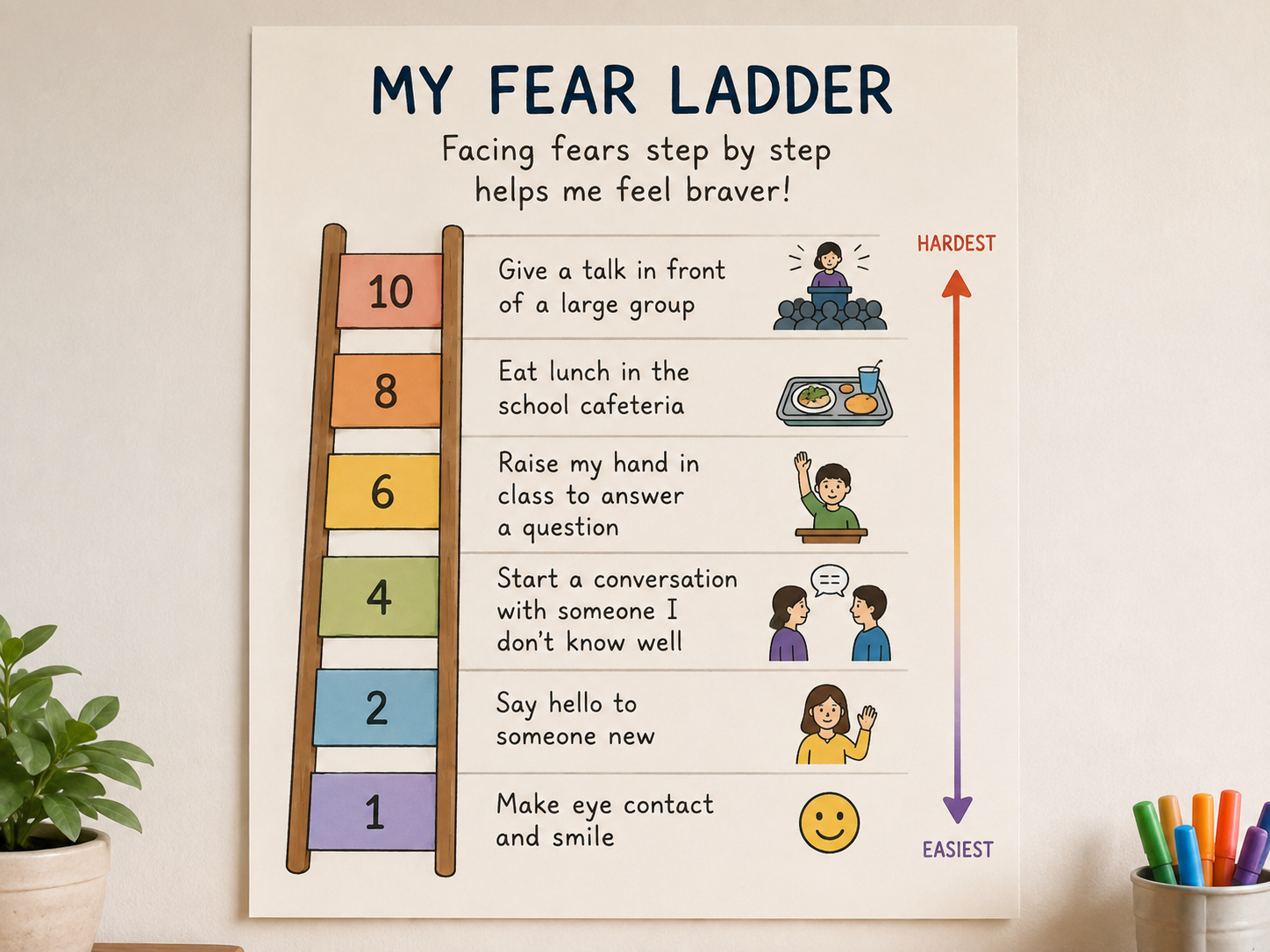
Exposure-based interventions, central to CBT for anxiety disorders, are also adapted. For younger children, therapists often use “bravery ladders” or “fear thermometers” to help them rate their anxiety and gradually approach feared situations (Kendall & Hedtke, 2006). Games, rewards, and role-playing can all be woven into exposure work to maintain engagement and motivation.
A Window into Practice: The Story of Lily
Consider Lily, a fictional nine-year-old girl who was referred for therapy because of increasing school refusal. Every morning brought tears, stomachaches, and pleas to stay home. Her parents were worried and exhausted. To understand the root of Lily’s distress, the therapist developed a comprehensive cognitive-behavioral formulation. This involved identifying predisposing factors, such as a familial tendency toward anxiety, alongside precipitating events like a recent difficult transition to a new classroom environment. By mapping out these elements, the therapist could clearly see how Lily’s physical symptoms and avoidance behaviors were being maintained by negative reinforcement. In therapy, Lily’s therapist used this formulation alongside a combination of psychoeducation and creative tools to help her understand the anxiety cycle.
Together, they drew a “worry loop,” a simple diagram showing how anxious thoughts (“Something bad will happen at school”) lead to physical feelings (stomach pain), which lead to avoidance (staying home), which temporarily feels better but actually makes the worry grow stronger.
Lily named her worry “The Blob” and began drawing it as a cartoon character. Over several sessions, she and her therapist built a bravery ladder, starting with small steps like packing her school bag the night before, then sitting in the car outside school, then walking to the school entrance, and eventually returning to class. Each step was celebrated, and Lily’s parents were coached on how to support her through the process, offering encouragement without accommodation.
By the end of treatment, Lily was attending school regularly. More importantly, she had learned a set of skills she could use whenever The Blob tried to take over.
The Essential Role of Parents and Caregivers
One of the most important differences between CBT with adults and CBT with young people is the role of parents and caregivers. In adult therapy, the client is typically the sole participant. In child and adolescent CBT, family involvement is often not just helpful—it is essential.
Parents can unintentionally maintain their child’s anxiety or behavioral difficulties through well-meaning accommodation. For example, a parent who allows a child to sleep in their bed every night to avoid nighttime fears, or who speaks on behalf of a socially anxious teenager, may be preventing the child from learning that they can cope. CBT with young people often includes parent sessions where caregivers learn about the model, understand their role in the maintenance cycle, and practice new ways of responding.
Research has examined how parents can most effectively participate in treatment for childhood anxiety. Manassis and colleagues (2014) found that CBT was effective with or without active parental involvement, although certain forms of parental involvement may help children maintain their treatment gains. Research by Lebowitz and colleagues (2020) further highlights the important role parents can play. In their study, a treatment that worked directly with parents to reduce family accommodation was as effective in reducing children’s anxiety as CBT delivered directly to the child and led to greater reductions in family accommodation.
Recognizing Authentic CBT for Your Child
For parents seeking therapy for their child, it can be difficult to know whether a therapist is truly delivering CBT or simply using the label. Here are a few signs that your child is receiving authentic, evidence-based CBT:
- The therapist sets clear, measurable goals with you and your child at the start of treatment.
- Sessions are structured and focused, not open-ended conversations without direction.
- Your child is learning specific skills, such as identifying thoughts, rating emotions, or facing fears step by step, rather than just “talking about feelings.”
- The therapist involves you in the process when appropriate, keeping you informed and coaching you on how to support your child at home.
- Progress is tracked and discussed regularly.
If these elements are missing, it may be worth asking the therapist about their approach or seeking a clinician with specialized CBT training.
Conclusion
CBT for children and adolescents is not a watered-down version of adult therapy. It is a thoughtful, developmentally informed, and often creative adaptation of a powerful therapeutic model. When delivered by a skilled clinician who understands both the science and the art of working with young people, CBT can equip children and teens with lifelong tools for managing their emotions and navigating the challenges ahead.
As our field continues to grow, it is vital that we train clinicians who can deliver authentic CBT to younger populations, and that we help parents recognize what genuine, high-quality treatment looks like. Our young clients deserve nothing less.
Watch the conversation with Dr. Hakan Öğütlü, and Dr. Katy Manetta for a deeper dive to this conversation on YouTube.
References
Friedberg, R. D., & McClure, J. M. (2015). Clinical practice of cognitive therapy with children and adolescents: The nuts and bolts (2nd ed.). Guilford Press.
Kendall, P. C., & Hedtke, K. A. (2006). Cognitive-behavioral therapy for anxious children: Therapist manual (3rd ed.). Workbook Publishing.
Lebowitz, E. R., Marin, C., Martino, A., Shimshoni, Y., & Silverman, W. K. (2020). Parent-based treatment as efficacious as cognitive-behavioral therapy for childhood anxiety: A randomized noninferiority study of Supportive Parenting for Anxious Childhood Emotions. Journal of the American Academy of Child & Adolescent Psychiatry, 59(3), 362–372.
Manassis, K., et al. (2014). Types of parental involvement in CBT with anxious youth: A preliminary meta-analysis. Journal of Consulting and Clinical Psychology, 82(6), 1163–1172.
Stallard, P. (2019). Think good, feel good: A cognitive behavioural therapy workbook for children and young people (2nd ed.). Wiley.
About the Author
Hakan Öğütlü, MD, MSc, is an Associate Professor of Child and Adolescent Psychiatry and a Consultant Child and Adolescent Psychiatrist based in Türkiye. He serves as Adjunct Clinical Associate Professor at UCD School of Medicine, Ireland, and is a Diplomate and Trainer Consultant of the Academy of Cognitive and Behavioral Therapies (A-CBT). Dr. Öğütlü is the Founder and Chair of the Eating Disorders Commission of the Turkish Association for Child and Adolescent Psychiatry and a Board Member of the Cognitive Behavioral Psychotherapies Association of Türkiye. He is also an EABCT-approved Cognitive Behavioral Therapist.