
When Parents Lose Control: Using CBT and DBT to Move from Shame to Repair
When Parents Lose Control: Using CBT and DBT to Move from Shame to Repair
Written by Matis Miller, LCSW, A-CBT, DBT-LBC

It's the end of one of those days in the Wilson family.
Over the course of a whirlwind Sunday, Mr. and Mrs. Wilson have shepherded their children - ages 4 to 12 - from Target to the supermarket and then to the ice cream store, all while trying to squeeze in work and household responsibilities.
Ten-year-old Aiden has been out of sorts all day: bothering his siblings, begging for candy and toys, complaining in the car, and having a meltdown at the ice cream store.
His parents keep their cool for most of the day, but their patience wears thin. When Aiden learns that dinner is leftovers, he stomps out of the kitchen and shoves four-year-old Mia out of his way. Dad finally snaps.
He grabs Aiden by the arm and hustles him into a bedroom, slamming the door behind him, and proceeds to berate him as all of the day’s annoyance boils over. He gets right into Aiden’s face: “You have been out of control all day! You’ve ruined the entire day for all of us. What were you thinking, pushing Mia like that? Next time we want to have a nice family day, we’ll leave you at home.” Ignoring the tears coursing down Aiden’s face, he departs with, “Now sit in your room and don’t come out until you’re ready to behave yourself.”
As Dad returns to the rest of his now-subdued family, the fury starts to subside, replaced by guilt. His inner voice soon takes on the same tone that he used with his son, but directed at himself this time. How could you let yourself lose control like that? You should be ashamed of yourself. He’s just a kid. You probably scarred him for life. Good going.
He considers apologizing to Aiden, but can’t decide if it’s the right thing to do. Shame, guilt, and rationalizing take over: If I start with the apologies, it will lessen the impact of the lecture I gave him. After all, it was important to tell him about his behavior so that he won’t do it again. He owes US an apology for the way he behaved. Parents aren’t supposed to apologize to their children. Better to just move on. Maybe I’ll offer to shoot some hoops or play a game with him to get past the awkwardness.
A game or treat may ease the awkwardness, but it will not repair the rupture. The hurt may linger for both father and son.
Additionally, Mr. Wilson’s harsh, self-critical thoughts are unhelpful. If his guilt is justified, he can use it to guide effective action: acknowledge what he did, apologize to Aiden, and repair the relationship. Stewing in guilt and continually berating himself can interfere with meaningful change.
Understanding the Behavioral Chain
A behavioral chain analysis allows us to slow things down and examine the sequence of events that led to Dad’s reaction. The accumulated stress of a long day, combined with his thoughts about Aiden’s behavior, steadily increases his frustration and emotional arousal. By the time Aiden pushes Mia, Dad is already at a boiling point and reacts impulsively. Once his arousal comes down, shame and harsh self-judgment take over, followed by the urge to avoid the discomfort of repairing what happened.
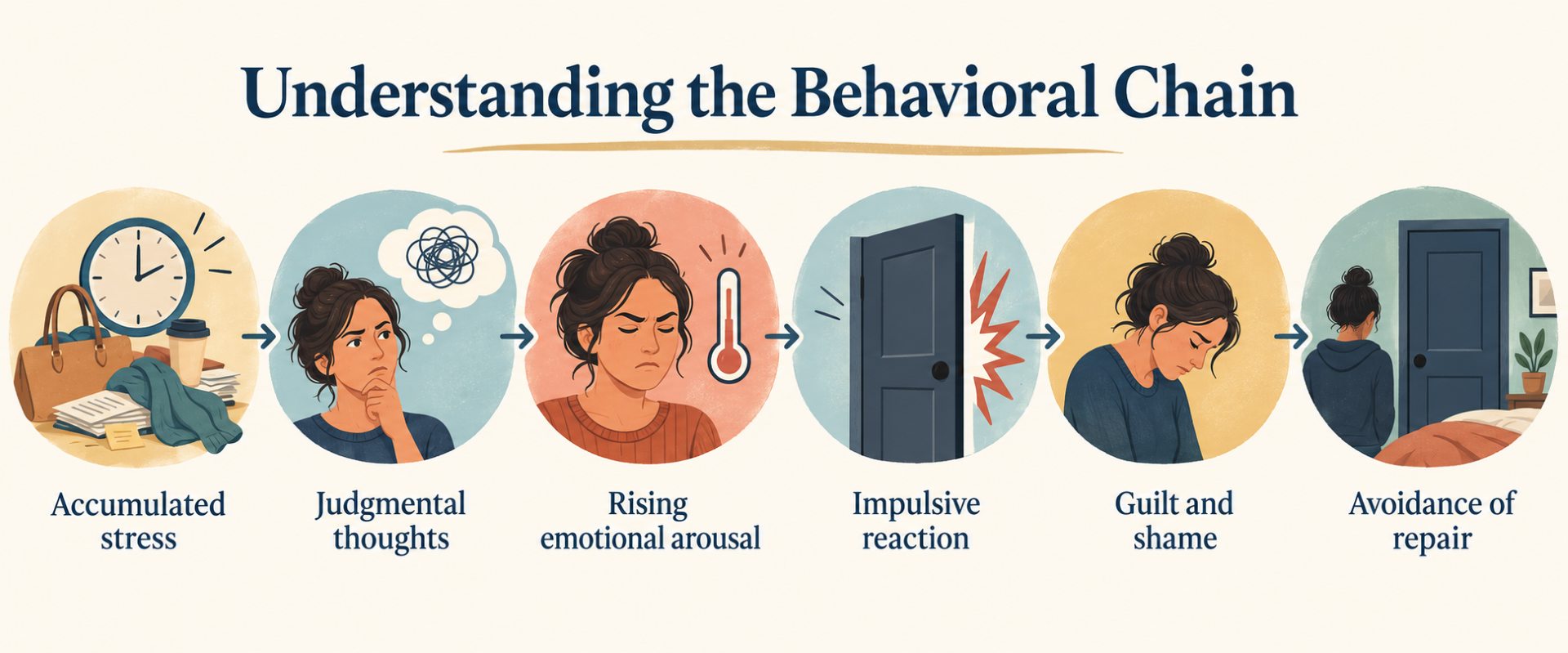
Seeing the chain does not excuse Dad’s behavior. It identifies the places where he can intervene differently next time.
Self-Compassion Is Not an Excuse
A more effective response begins with self-compassion, but self-compassion is not the same as excusing or minimizing harmful behavior. Attacking himself may feel like accountability, yet it can push Dad toward defensiveness and avoidance. Acknowledging how overwhelmed he became can help him take responsibility, make repairs, and respond more effectively.
A more balanced and effective response to these thoughts might be: It really was a tough day today, and I didn’t lose my cool for most of it. I’m a good father who responded in a harmful way, and I need to deal with it properly. Next time, I need to give myself a time-out to collect myself and get my emotions under control, even if it means that I’ll have to wait to deal with Aiden properly.
Dad can also reconsider his judgmental thoughts about Aiden: He is a child who had a difficult day, not a child who ruined the family’s day. Next time, the family may need fewer errands, a snack, or time for him to move and decompress. Understanding Aiden’s vulnerabilities does not erase the limit against pushing his sister; it helps Dad respond more effectively.
Moving from Shame to Repair
Next, he corrects his thinking errors. If anything, apologizing to him will be a good lesson. I can model a proper apology, and I think everyone will feel better afterward. Shame is prompting Mr. Wilson to avoid Aiden or rationalize what happened. Using the DBT skill of opposite action, he instead approaches Aiden sincerely, takes a few mindful breaths, and speaks calmly to his son.
Although Aiden initially responds with silence and irritation, which starts to fire up his father’s frustration again, Dad says his piece: I was angry, but grabbing you and speaking to you that way was not okay. You did not deserve to be treated that way, and I’m sorry. He is careful not to follow the apology with a “but” statement like I shouldn’t have yelled at you, but you were driving everyone crazy with your behavior.
He can include a brief explanation (not an excuse): I was tired and hungry and a little stressed out. I know I hurt your feelings. I’ll try my hardest not to do it again.
Apologizing does not mean ignoring Aiden’s behavior or removing the limit. Once things are calm, Dad can still address it clearly: It’s okay to be upset about dinner, and it’s not okay to push your sister. We’ll need to figure out how you can handle that differently next time. Dad can also make his own plan: notice when his frustration is building, take a brief time-out before responding, and return to address the behavior once he is calmer.

Planning for the Next Difficult Moment
In a best-case scenario, Aiden will open up about his experience, sharing that he really wanted to have hot dogs for dinner, that he was so hungry, that he felt nauseous in the backseat, and that he is nervous about starting a new camp. In a typical scenario, he may shrug and move on, but his father will know that he modeled a proper apology and maintained the appropriate limit.
Repair also includes planning. Dad can learn his early warning signs - a tightening jaw, a raised voice, or thoughts that Aiden is ruining everything - and respond before reaching the boiling point. He might ask his spouse to step in briefly, take a short break, regulate his breathing, and postpone consequences until both he and Aiden are calmer.
If this is a common occurrence in the Wilson home, it would be wise for Mr. Wilson to reach out for help. There is no shame in having a hard time with a child whose behavior feels especially challenging. It can be helpful for him to learn effective parenting strategies while also learning to regulate his own emotions.
Parents will sometimes respond in ways they regret. CBT and DBT offer something more useful than either self-condemnation or making excuses: a way to understand the chain, take responsibility, repair the relationship, and build a more effective response for the next difficult moment.
About the Author
Matis Miller, is the founder and director of The Center for Cognitive & Behavioral Therapy of New Jersey, the founder and clinical director of InReach Behavioral Health, an intensive outpatient and partial hospitalization (IOP/PHP) program, and author of the groundbreaking book The Uncontrollable Child, which has been translated internationally.
He is a licensed clinical social worker with over 20 years of experience. His extensive educational and training background includes certification in CBT from the Academy of Cognitive Therapy and the Beck Institute for Cognitive Behavior Therapy, certification in DBT from the DBT-Linehan Board of Certification, and certification in Schema Therapy from the International Society of Schema Therapy.
Matis specializes in severe emotional and personality disorders, anxiety in teens and adults, and parent training. He is a seasoned lecturer on CBT- and DBT-related topics, addressing parents, clients, and professionals, and is presently focused primarily on supervision, education, and consultation.
Reference
Morris, A. S., Silk, J. S., Steinberg, L., Myers, S. S., & Robinson, L. R. (2007). The role of the family context in the development of emotion regulation. Social Development, 16(2), 361-388. https://doi.org/10.1111/j.1467-9507.2007.00389.x
Watch The Conversation on Youtube: https://youtu.be/cFRNPmcilWQ